

Beyond Fine: The Hidden Language of Emotions

For years I believed emotions came in only a handful of varieties.
Happy. Sad. Angry. Scared. Maybe excited if it was a particularly good day.
Everything else felt like static. A tightness in my chest, a lump lodged in my throat, an ache beneath my ribs that arrived without explanation and lingered without invitation.
Someone would ask how I was doing, and I'd reach automatically for the stock answer,
"I'm fine."
Looking back, those weren't emotions. They were placeholders.
I sometimes wonder how different our lives might have been if we had inherited a richer emotional vocabulary instead of the hollow reassurance of fine. How differently we might have understood ourselves if someone had taught us that “fine” was not always a feeling, but sometimes a hiding place.
Many of us grew up in homes where emotions were not explored. They were managed.
We learned which five feelings were acceptable and which had to be hidden. Anger might have been punished, sadness ignored, fear dismissed, joy interrupted by responsibility. Before long, we stopped asking what we felt and began asking which version of ourselves would keep everyone else comfortable.
Growing up, I rarely asked myself how I felt. My father struggled with mental health issues and coped with alcohol and drugs. I remember the particular quiet of our house on the bad nights - the suspended stillness before a storm, when every sound seemed capable of changing the weather.
I learned to read a room the way other kids learned to read books. A shift in someone’s voice, the weight of a footstep. The closing of a door. Each carried information.
When a child is raised in survival, fear does not always announce itself as fear. Sometimes it looks like vigilance. Sometimes it becomes helpfulness, obedience, humor, silence, or the ability to disappear without leaving the room.

I was not exactly forbidden from having feelings. It was more complicated than that. There was simply no
safe place for them to land. My attention belonged to the emotional needs of the people around me, and so I learned to feel what the room required before I learned to recognize what was happening inside me.
Somewhere along the way, many of us became fluent in responsibility while remaining nearly illiterate in our emotional selves.
The Feelings Beneath the Feelings
Sometimes we call ourselves angry when we are actually hurt. We say anxious when grief is moving beneath the surface. We say tired when we are lonely. We call it stress when the deeper wound is betrayal. We call it busyness when we are avoiding what silence might reveal. We call it burnout when we have spent years quietly abandoning our own limits.
Words matter because they give shape and color to what had previously existed only as a sensation.
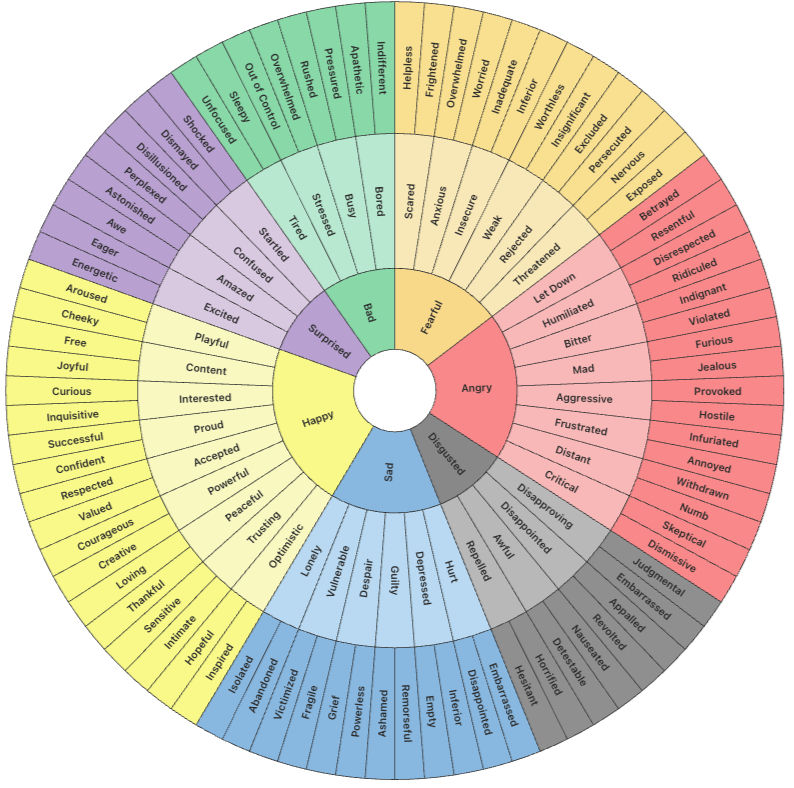
Psychologists have a name for the ability to distinguish among closely related emotions rather than lumping them into one vague experience: emotional granularity.
Researcher Lisa Feldman Barrett, whose work examines how the brain constructs emotional experience, has written extensively about this capacity. Greater emotional precision does not mean that we stop experiencing grief, fear, anger, or pain. It means we become more capable of recognizing what is happening and choosing a response that actually fits the experience.
That distinction matters because not every emotion requires the same response.
Loneliness may ask for connection.
Resentment may point toward a boundary crossed too many times.
Shame may need compassion.
Grief may need witness rather than advice.
Exhaustion may not need a better attitude. It may need rest.
When every difficult feeling is labeled bad, stressful, or too much, we lose access to the information it may be carrying.
Something remarkable can happen when we accurately name an experience: it becomes less frightening, less mysterious, and sometimes less overwhelming. The body may soften when the mind can finally say, “Oh. That is what this is.”
The overwhelm I used to call stress was often dread - the feeling of anticipating a collapse before it had even arrived.
The flatness I called fine was sometimes peace: quiet, earned, and easy to mistake for numbness when I had spent so long accustomed to chaos.
The irritation I called anger was often resentment, worn smooth from being carried too long without acknowledgment.
The heaviness I called sadness was frequently longing for a version of home, love, or myself that had never fully existed.
And the rare, wide-open feeling I called happy?
That one, I eventually realized, was often awe.
When Feelings Arrive All at Once
The last two years have tested this language in ways no workbook, training, or years of personal reflection could have prepared me for.
The emotions did not arrive one at a time, politely identified and waiting to be processed. They came tangled together.
I have spent years learning to identify what I feel, trace where it comes from, and respond with great awareness instead of simply reacting. But there is a difference between naming a single feeling and trying to understand yourself when emotions arrive stacked one upon another - sticky, contradictory, torturous, an all-at-once shit storm with no clean edge and no obvious beginning.
In those moments, all the vocabulary in the world can feel like too many words for too much weight.
Sometimes we have to set nuance aside and return to the basics - sad, scared, angry - simply to find solid ground before we can begin sorting through what is underneath.
There have been moments when I have felt both frozen and shattered, unable to move forward yet unable to stop feeling everything at once. I pulled my car over to release tears and sounds I never knew my body was capable of creating.
They did not feel like thoughts. They felt ancient - grief escaping from a place language had not yet reached.
At first, I cycled through the words, helpless, hopeless, abandoned, disrespected, rejected, repeating them in my mind and testing each one against the sensations in my body.
Some were true, but none were complete.

Eventually, I understood that I was not feeling one clean emotion. I was grieving several losses at once: the
loss of what had happened, the loss of what I had hoped might still happen, and the loss of the version of myself who had continued waiting for a different ending.
There was rejection in it, but also disillusionment.
There was abandonment, but also relief.
There was anger, tenderness, humiliation, love, and the terrible clarity of finally seeing something I had worked very hard not to see.
No single word could contain it because no single loss had created it.
One of the most liberating things I have learned is that emotions do not arrive democratically, one at a time.
We can love someone and know we cannot continue living beside them.
We can feel relief after a loss and still grieve what has ended.
We can be grateful for a life and exhausted by the effort required to hold it together.
We can miss a version of home that was never entirely safe.
Contradictory feelings do not mean we are confused or dishonest. They often mean the truth is larger than one word.
The experience has not disappeared, but it has become more understandable, and what becomes more understandable is often easier to hold with compassion.
The Difference Between a Feeling and a Story
Developing an emotional vocabulary also requires learning that a thought is not the same thing as an emotion.

“No one will ever stay” is a thought.
“I am unlovable” is a belief.
“They have not called me back” is an observation.
“They are deliberately rejecting me” is an interpretation.
The heaviness in my chest is a bodily sensation.
The feeling beneath all of it might be fear, grief, shame, disappointment, or loneliness.
These experiences influence one another, but they are not interchangeable. Learning to separate them creates a little space between what happened, what we concluded, and what we choose to do next.
The small space is not emotional detachment.
It is agency.
These words are not decoration. They are maps. Without them, every unfamiliar landscape can feel dangerous. With them, we begin to recognize where we are, what has brought us there, and what direction might lead us home.
The Language Hidden Inside Art
As someone who teaches through story and film, I have become fascinated by the emotional vocabulary hidden inside great art: a camera lingering after a character has stopped speaking, an empty chair held in the frame, the way afternoon light falls across someone’s face, a person staring through a window while the world continues behind them.
No one says, “She’s grieving.”
Yet we know.
Art speaks in a language that often reaches us before words do.
Perhaps that is why beautiful stories help us recognize feelings we have not yet learned to explain. Sometimes we borrow the language of a novel, a poem, a photograph, or a film until our own language begins to return.
Long before I understood emotional granularity, I understood recognition. A photograph could leave me

in tears without knowing why. A scene in a film could stay with me for days. A line from a novel could feel as though someone had quietly reached into my chest and named something I had never been able to describe. Art often becomes our first emotional translator, helping us recognize experiences we feel long before we know what to call them.
A story can offer emotional recognition without demanding immediate explanation.
We see a character hesitate at a doorway and recognize ambivalence.
We hear a voice tremble beneath ordinary dialogue and recognize fear.
We watch someone pack a suitcase with unbreakable care and understand that grief can coexist with certainty.
Art does not always tell us what to feel. At its best, it gives us permission to notice what we already do.
Instead of asking, “How do I stop feeling this? Perhaps we begin asking, “What is this asking me to notice?”
The first question reaches for escape.
The second creates the possibility of understanding.
Not every feeling carries a hidden lesson, and pain does not need to be romanticized to be worthy of attention. Sometimes the message is simply that something hurt.
That is enough.
One Truer Word
Today, when someone asks how I am doing, I try to pause before answering - not because I have become emotionally perfect, but because I have learned that there are far more possibilities than fine.
Sometimes I am peaceful. Sometimes uncertain. Sometimes I feel deeply blessed and profoundly heartsick in the same hour.
Of course, knowing what we feel does not mean everyone is entitled to hear it. Discernment, deciding who has earned access to our inner life, is a different kind of emotional wisdom.

Human beings were never meant to fit inside a single feeling.
Neither were our stories.
The richer our emotional vocabulary becomes, the more fully we can inhabit our lives not because we begin experiencing more emotions, but because we become better able to understand the conversations among our bodies, histories, beliefs, and present circumstances.
What once felt like chaos begins to reveal patterns.
What once felt like personal failure begins to look more like adaptation, grief, longing, protection, or need.
When a vague feeling arrives, I sometimes begin with four questions:
What is happening in my body?
What story is my mind telling me? And when was this first told?
What are the emotions buried beneath the story?
What might these need from me now? And how can I positively express and hold myself now?
The purpose is not to interrogate until every feeling is perfectly accounted for and labeled. It is to become a little more curious and a little less afraid of our own interior life.
So the next time someone asks how you are doing, pause before reaching for fine.
You don’t own them your entire interior world, but you might offer yourself one truer word.
See what becomes visible when the language becomes more precise. And if you are in a season of emotional overwhelm, return to the simplest words: sad, scared, angry, or tired.
Emotional fluency is not a performance, and healing is not a vocabulary test. Sometimes one honest word is enough to give the body somewhere to stand.
We may not have inherited the language we needed.
But we can learn it now - word by word, story by story - until fine is no longer the only doorway available to us.




Comments